CQ Worldwide DX Contest, CW
Call: EA5ON
Operator(s): EA5ON
Station: EA5ON
Class: SOSB(A)/15 QRP
QTH: Valencia
Operating Time (hrs):
Summary:
Band QSOs Zones Countries
------------------------------
160:
80:
40:
20:
15: 351 28 100
10:
------------------------------
Total: 351 28 100 Total Score = 93,056
Club: Torrent Contest Club
Comments:
Wow! What a fun time!
I am an almost exclusively phone op and only started very low-key CW contesting
in 2010. This year I hadn’t taken any decision about CQWW until the Thursday
evening when I decided I would once again do a s+p QRP monoband effort. I also
decided that since I hadn’t done any practice in the last year, and hardly
any CW DX QSOs, it would be a good idea to go assisted. Normally I don’t use
the cluster for SO phone contesting but for this event it would probably reduce
my busted calls a lot and help me out a bit. It looked like I had an SWR
problema with the antenna and was all set to do 20m but a niggling thought made me take
the amp, ATU, and low pass filter out of line and test directly at the rig.
Bingo! Low SWR, so I decided on 15m. I downloaded N1MM to my new PC, did a half
hour session on Morse runner, and went to bed.
Saturday looked good to start off and I managed to make a good number of QSOs,
once I remembered how to send my call and check the cluster calls were OK. No
CAT from computer to rig, so I had to tune the rig manually to the spot
frequencies and do all the sending with the paddle. After a while I tried CQing
at the top end of the band, but following a couple of disastrous attempts at a
QSO I decided to revert to s+p. There were lots of calls not on the cluster but
a lot of those ops were so fast it was impossible for me to copy, so I decided
to concentrate on getting multipliers. Some of the pileups were pretty tough
and no way to break the KH0 or KH2 piles, I could also hear KL7 but didn’t
even attempt it. Slowly the count kept creeping up, but unlike other contests,
very few USA stations spotted. At evening mealtime the band was dead, a quick
check revealed a half time score of 178 qsos, 22 zones, and 73 countries. This
was already better than my best previous score. After dinner I decided to take
a spin round a dead band and was rewarded with multipliers from HK and Z8.
Sunday I decided that it would be hard to pick up many more multipliers with my
puny 5w and decided to try to work the bandmap a bit more intensively. At first
most eastern stations did not copy, with their beams all towards JA, but slowly
but surely the band opened up a bit and I was able to get a few in the log. I
was also able to work Japan, China, and Mongolia, all for double mults. As we
were sitting down for lunch I saw a spot for VK2IM pop up and I tuned to his
frequency, there he was and no pileup! But the dirty looks from the family put
paid to that and by the time I got back, he was gone. Another afternoon without
much in the way of spots so I ended up using my ear, who knows what my busted
call rate will be for those ones. I managed to break a few pileups for mults
like Iceland, Greenland, and Isle of Man, but no such luck with Jersey,
Shetland, or Crete. Once the band was almost devoid of stations I tuned around
again and to my astonishment a barely audible 9L1A pulled me out of a pile for
country number 100. I then tried for ZF1A but no such luck and finally after
working a few Brazilian stations, called it a day.
I realized after doing this that I could have tried using skimmer/RBN for this,
as a phone op I forget these things exist! This might have helped me boost my
score. I also continue to be amazed at the skill of so many ops who were able
to pick my 5w signal out of the noise over and over again. I take my hat off to
these people, hardware helps make a big score but in the end these guys are
just super ops and I congratulate all those who made a big score through their skill
and effort.
Thanks to all for the QSOs.
Rig: IC765
Pwr: 5w
Ant: Optibeam OB6-3M
73 de Duncan EA5ON
Saturday, November 30, 2013

Thursday, November 07, 2013
ED5T CQWW SSB 2013
The link is posted on the contesting page too but here it is again:
http://www.3830scores.com/showrumor.php?arg=kJaRzLfcmamiX
The video:
And the spanish extended text:
http://www.3830scores.com/showrumor.php?arg=kJaRzLfcmamiX
The video:
And the spanish extended text:
Por fin llegó la hora de la verdad, la prueba del algodón: CQWW! El momento de poner en marcha todas las mejoras de la estación para ver si todo funcionaba en su conjunto.
ED5T tiene su QTH en el alto de El Vedat (Torrent). Es desde luego un lugar privilegiado para hacer radio, y no es por nada que allí estamos rodeados de torres de radiodifusión, televisión, y telefonía. Para una estación de concursos de HF tiene una ventaja adicional, que es la caída brusca del terreno hacia el norte. No obstante, tener una estación de estas características no está exento de problemas. Al pertenecer al ayuntamiento y estar cedido a la STL de URE, estamos sometidos a una serie de restricciones en cuanto a qué antenas podemos montar y luego mantener. Y, cada vez que hay que hacer algo, tenemos que desplazarnos de nuestras casas. Esto quiere decir que muchos de los trabajos se hacen contrarreloj y no se puede hacer pruebas exhaustivas. También quiere decir que algunas cosas se tienen que montar de forma provisional cada vez que hacemos un concurso.
Durante el último año se han hecho bastantes cambios. Es cierto que la yagi de 40m se había probado bien en el concurso de la ARRL, y después de hicieron unas mejoras en base a los resultados. Las dos antenas para 15m se probaron bien en el concurso de la IARU y funcionan correctamente. Pero teníamos las antenas nuevas para 10m que no se habían probado apenas, y también la L invertida para 160m que no se había hecho ni un solo contacto, solo habíamos comprobado el ROE. Los juegos nuevos de stubs para combatir la interferencia entre las dos estaciones se había hecho esta vez meticulosamente usando el mini-VNA y mostraron un rechazo muy bueno, pero se habían montado en su caja el miércoles antes del concurso y sin hacer ninguna prueba de si funcionaban o no. Un año más, habíamos decidido montar antenas de recepción tipo Beverage. Esto implica montar dos antenas muy largas a poco altura, en un bosque donde hay senderos y pueden pasar personas, bicicletas, y hasta caballos. Se monta a última hora, y como siempre, nos pilló el toro, poniendo las picas y coaxiales con linternas, todo el mundo sudando y jurando.
Con esto quiero decir que aunque a priori una estación de este tipo tiene buena ubicación para radio, normalmente llegamos todos muy cansados antes de siquiera empezar a operar. Por lo menos este año hemos introducido un elemento lúdico que es la barbacoa antes de empezar el ´test.
Arrancamos muy bien. Yo me había ido a dormir y al venir a las 7 de la mañana me encontré con Victor EA5KV. Primero me contó las buenas noticias, que en lugar de quedarse en las bandas bajas, se había quedado en 20m haciendo running de americanos casi toda la noche. El horario ponía que se turnaba con nuestro invitado Andreu EC5AA pero Andreu quiso quedarse haciendo multiplicadores y la verdad es que los dos hicieron una noche memorable, ayudado por Elías EB5KT y Juan Carlos EA5UF. Las malas noticias, que nadie le había dicho a Andreu que el rotor T2X en torre 2 se engancha con frecuencia y que no se debe acercar a los topes por si se enganchaba allí. Tuvimos la mala suerte que pasó justamente eso y se nos quedó la yagi de 40 mirando hacia el este y la yagi de 15 mirando hacia el sur. Intentamos arreglarlo de noche y a lo bruto, pero no funcionó. Afortunadamente Andreu pudo encontrar una solución y cuando era de día ya giraba todo otra vez.
En ese momento, parecía que la meta que había propuesto quizás se podría alcanzar. No obstante conforme iba pasando la mañana, se nos iban disipando las esperanzas. Nos costaba mucho mantener buenos rates en 10 y en 15 metros, a pesar de tener un SFI de unos 160. Al parecer, la buena propagación se había quedado más al norte, y aunque pudimos trabajar bastantes multiplicadores, no entraban una gran afluencia de corresponsales, ni de Asia ni de Europa. Por la tarde cuando ya debían estar entrando USA con fuerza, notamos otra vez lo que había sido la tónica de la semana anterior, que era la banda abierta hacia el este hasta bien entrada la tarde, con algún americano intercalado, y luego sobre las 6 de la tarde, alguien abrió la propagación a Norteamérica de repente. En este sentido fue de gran ayuda tener este año los stacks, pudiendo trabajar en dos direcciones a la vez, y luego tener más zona de USA abierta al mismo tiempo.
Por la noche probamos las bandas bajas en running pero en 40 era imposible encontrar un hueco para trabajar USA en simplex y acabamos en Split, como en los buenos tiempos. Aunque las antenas de RX no estaban pensados para 40, hicieron un papel bajando bastante el splatter que había, así no era tan cansado para el operador. A pesar de todo llegamos a tener buen rate y solo decidimos volver a 20 al ponerse uno muy fuerte al lado de mi frecuencia de TX. El FT2000 parece que tiene algún problema con el segundo receptor, así que transmitía con la sub y escuchaba el Split en el Main, que era donde llamaba la mayoría de la gente. Más de una vez me llamó algún americano en mi frecuencia de TX. Y lo divertido era ver que los canadienses, que pueden usar toda la banda, llamaban indistintamente por un oído o por otro! 80m era terrible, oíamos que contestaban americanos pero el ruido era tan alto que no se entendía nada. Así que, otra vez a 20m a terminar la noche, pero esta vez sin la gran afluencia de estaciones.
El domingo era una repetición del sábado pero que se notaba durante el día que era más difícil oír a las estaciones más débiles. Aun así, fuimos capaces de trabajar algún que otro multiplicador durante el día y poco a poco iba subiendo la puntuación. Notamos por la tarde en 10m que la antena de abajo era la que mejor funcionaba para la costa oeste, mientras que la de arriba iba mejor para el centro y costa este. Llegamos a pensar que estaban conectados al revés! Pero no, era así, incluso con esa antena y haciendo americanos, me llamó E51USA desde las islas Cook y un neozelandés. A dos horas de terminar, Elías me pasó los cascos, que había americanos débiles que a lo mejor yo podría sacar con más facilidad que él. Me puse, y opté por cambiar de frecuencia, buena decisión porque pude hacer un run de unos 400.000 puntos en una hora, que nos acercaba otra vez a la posibilidad de igualar el record de EA en Multi Single. A falta de una hora, me empezaba a notar cansado y que me bajaba un poco el rate así que se lo pasé a José para que terminara. Hizo todo lo que pudo pero al final nos quedamos un pelín por debajo de los 12 millones de puntos. A destacar en esa última hora, un minuto donde hicimos 4 multiplicadores!
A partir de allí, otra vez a desmontar. Ya habíamos quitado los beverage por la tarde (1km de antenas y 400m de coaxiales), y cuando ya no quedaba propagación en 10, quitamos los cables del stack de 10m, pero aun así tocó recoger los radiales de 160m, bajar la torre motorizada y dejarla arriostrada, recoger los equipos, amplis, cajas de antenas de RX, volver a poner los equipos que normalmente están, y hasta barrer el suelo…..
No somos una estación líder en EU, ni lo seremos nunca, pero este año nos ha dado mucha satisfacción tener una buena puntuación y sobre todo, ver que todo el trabajo hecho nos ha valido la pena. El único ataque de Murphy fue el rotor, el resto de las cosas han funcionado según previsto. Aunque nunca estás a salvo del todo de Murphy, también es cierto que las cosas bien planteadas y bien acabadas suelen dar menos problemas. En este sentido es destacable la labor de nuestro amigo Juan EA5GIE, con un montonazo de experiencia en temas tanto mecánicos como electrónicos. Juan siempre está a pie del cañón con sus ideas, sus inventos, y sus sugerencias. No opera fonía, pero eso no ha sido motivo para no estar con nosotros este fin de semana, hasta el final de la recogida de trastos a las dos de la mañana. Desde aquí, gracias Juan, por tu incansable aportación al equipo.
Como siempre, nada de esto sería posible sin la ayuda de mucha gente, nuestras familias, el ayuntamiento, y nuestros compañeros de URE Torrent, gracias a todos por la ayuda, directa o indirecta, que nos permite disfrutar de esta afición.
Sunday, October 13, 2013
Countdown to CQWW
Two weeks to go and as usual we still have loads of things pending.
Today we had a short morning session to do a few more things. First off was to prepare the new stub location. Up until now the stubs were just thrown on the floor of the shack, since as we used to use two tribanders, we often needed to change the stubs on the coax of both tribanders. Now that we have monobanders for 10 and 15 metres, there will be virtually no stub changing to do, so we are going to locate the sixpack (and later eightpack) relay box and all the stubs in a cabinet outside the bunker.
The cabinet came from a scrapped tile factory and our first job was to empty it, here is Victor with the completed article:


A nice job by Juan and Elías, especially the double stub for 40m. These have been tested on the VNA and give over 50dB attenuation.
Here's the cabinet ready for hanging and then installing the relay box and all the stubs.

That will be a job for another day.
 We then went on to look at the cabling for the 10m stack, which we finished last week and looks as above. Elias couldn't come today so we were left wondering which of the following cables was the one for the stackmatch controller:

Jose and Juan helped Victor get this all sorted while I went away to the bunker to check the EQ settings on the FT2000D. When I finished, the guys had already got it all hooked up, and also reeled together with the coax cable and rotator cable, all ready to roll out to the tower on our new hose reel, courtesy of Juan.

Eventually we will bury all of this but in the meantime this is a quick and practical solution.
More updates to follow as and when available.
Only two weeks to CQWW phone!
Today we had a short morning session to do a few more things. First off was to prepare the new stub location. Up until now the stubs were just thrown on the floor of the shack, since as we used to use two tribanders, we often needed to change the stubs on the coax of both tribanders. Now that we have monobanders for 10 and 15 metres, there will be virtually no stub changing to do, so we are going to locate the sixpack (and later eightpack) relay box and all the stubs in a cabinet outside the bunker.
The cabinet came from a scrapped tile factory and our first job was to empty it, here is Victor with the completed article:
Next, we needed to make sure that the stubs would fit. The biggest one is still missing, but we reckon it'll be ok.
A nice job by Juan and Elías, especially the double stub for 40m. These have been tested on the VNA and give over 50dB attenuation.
Here's the cabinet ready for hanging and then installing the relay box and all the stubs.
That will be a job for another day.
Jose and Juan helped Victor get this all sorted while I went away to the bunker to check the EQ settings on the FT2000D. When I finished, the guys had already got it all hooked up, and also reeled together with the coax cable and rotator cable, all ready to roll out to the tower on our new hose reel, courtesy of Juan.
Eventually we will bury all of this but in the meantime this is a quick and practical solution.
More updates to follow as and when available.
Only two weeks to CQWW phone!
Sunday, September 22, 2013
Stacked yagis - getting closer to completing our 5 over 5 stack on 10m
As usual in the summertime our antenna antics take a back seat. Metal is too hot to touch, we are all busy doing other things, and its not until summer is almost over that we get back to work.
In July we already had a lot of the prep work for the tower and antennas done. In fact the yagis were already assembled and we had done some provisional tuning of one of them.
Yesterday we got together to do a bit more work. First, we had to tilt over the tower. Right now its just 6 metres high with a rotator cage and mast at the top

This tower is on a hinged base

We turned the antenna round so we could remove the 1:1 balun and replace it with the phasing lines to the stackmatch, with rf choke coil incorporated

Elias and I each brought our own RigExpert AA-30 analysers

These are great little toys. They are not at all affected by the high level of RF radiated by the cellphone tower nearby. Our old MFJ 259 was completely unusable here. Antenna number one was checked, approved, put up in the air to ensure it was the same at 8 metres high, then taken down and taken off the tower. Antenna number two was put in place and we did the same, putting on the coax and choke assembly and checking resonance.
Both antennas are home made, built to the YU7EF specs you can see here
Next job was to cut and prepare guy wires. The tower had been held up over the summer with provisional ropes.

The tower went back up, and while Elias and I checked out the curves on the analyser, Jose Belar and Vic got to work on terminating the bottom ends of the guy wires.
Here's Belar tightening the tensor clips at one end.

And here's what it looks like after finishing. We did a quick test hooking it up to my car to make sure the SWR on the rig was the same as on the analyser, and also to check there is no QRN problem. I made a quick contact with a UA6 station with the antenna pointed towards the states, seems all is OK.

Hopefully in the next couple of weeks and before CQWW and the wet weather come around, we can put up the complete tower with both antennas, rotator, and stack match.
In July we already had a lot of the prep work for the tower and antennas done. In fact the yagis were already assembled and we had done some provisional tuning of one of them.
Yesterday we got together to do a bit more work. First, we had to tilt over the tower. Right now its just 6 metres high with a rotator cage and mast at the top

This tower is on a hinged base

We turned the antenna round so we could remove the 1:1 balun and replace it with the phasing lines to the stackmatch, with rf choke coil incorporated

Elias and I each brought our own RigExpert AA-30 analysers

These are great little toys. They are not at all affected by the high level of RF radiated by the cellphone tower nearby. Our old MFJ 259 was completely unusable here. Antenna number one was checked, approved, put up in the air to ensure it was the same at 8 metres high, then taken down and taken off the tower. Antenna number two was put in place and we did the same, putting on the coax and choke assembly and checking resonance.
Both antennas are home made, built to the YU7EF specs you can see here
Next job was to cut and prepare guy wires. The tower had been held up over the summer with provisional ropes.

The tower went back up, and while Elias and I checked out the curves on the analyser, Jose Belar and Vic got to work on terminating the bottom ends of the guy wires.
Here's Belar tightening the tensor clips at one end.

And here's what it looks like after finishing. We did a quick test hooking it up to my car to make sure the SWR on the rig was the same as on the analyser, and also to check there is no QRN problem. I made a quick contact with a UA6 station with the antenna pointed towards the states, seems all is OK.

Hopefully in the next couple of weeks and before CQWW and the wet weather come around, we can put up the complete tower with both antennas, rotator, and stack match.
Thursday, September 05, 2013
HamLog from Pignology, a solution to portable logging
I'm an old fashioned kind of a guy and pretty much behind the times in a lot of things. I guess it runs in the family, since my dad classifies himself as "low-tech" :). Although for contesting we have lots of fun devices and use computer logging etc, I've only just started using computer logging at home this last year (I use logger32, after seeking a lot of advice). And in the car, since I don't have a computer, its old fashioned log book and pen.
However I suppose its inevitable to get caught up in change and last year I found myself wondering if any of the electronic gadgets I carry around in my bag could be used for logging. I shot out a few questions on forums and while it seems like Android users had an option with Amateur Radio Call Log, there was nothing for BlackBerry or for iPod. I asked the Maclogger developers if they were considering making that App available for iPod touch but no reply.
Whilst looking something up on QRZ.com the other day, I saw a banner ad for a firm called Pignology, and out of curiosity clicked to see what it was. Pignology is a small company run by Nick N3WG that produces apps for amateur radio, amongst which is HamLog, an logging App available for iPhone, iPad, and,...iPod touch! So, 89 cents and a download later, I am now set up to run a digitalised log, which in theory I will be able to export later to my PC via iTunes. This is not only great for the car, but also for when I finally manage to get my bicycle mobile back on the radio. Thanks, N3WG!
However I suppose its inevitable to get caught up in change and last year I found myself wondering if any of the electronic gadgets I carry around in my bag could be used for logging. I shot out a few questions on forums and while it seems like Android users had an option with Amateur Radio Call Log, there was nothing for BlackBerry or for iPod. I asked the Maclogger developers if they were considering making that App available for iPod touch but no reply.
Whilst looking something up on QRZ.com the other day, I saw a banner ad for a firm called Pignology, and out of curiosity clicked to see what it was. Pignology is a small company run by Nick N3WG that produces apps for amateur radio, amongst which is HamLog, an logging App available for iPhone, iPad, and,...iPod touch! So, 89 cents and a download later, I am now set up to run a digitalised log, which in theory I will be able to export later to my PC via iTunes. This is not only great for the car, but also for when I finally manage to get my bicycle mobile back on the radio. Thanks, N3WG!
Wednesday, August 07, 2013
Metron 1000 amplifier
The Metron 1000 was probably the first commercially made solid state mobile amplifier, from circa late 1970s. Rumour has it that the same design is still in use today by the military under the Datron name. From what I can tell, the amplifier is basically bulletproof, unless you do either of two things: One, drive it with more than 70w, or two, let it get too hot.
I had the opportunity to get one of these amps in the states, however it had to sit on a friend's desk in the New York office for about nine months before one of my colleagues brought it back with him on the plane (big TNX to Julio, Cristi, and Lenny). As expected for the era, it weights a ton and was not designed to fit in the back of a modern day 2013 car!

Good chunky heatsink on it, but no fans.
I finally got a chance to test this out in the car last sunday, and took down my MFJ989 to use as a power meter (it's the only one I've got!)
Here's what the mess looked like all hooked up in the back

It took me a while to figure out how to hook it all up. It came with a home made remote system which is not marked at all! At least I had been told it was wired for Kenwood and when the 8 pin DIN plug was plugged in and the mic keyed, a relay went "clunk" somewhere....

As far as I could tell, you can choose between using the front panel bandswitch, or, putting that switch to remote, and using the remote. I could not get the front panel to work at all. And on the remote, I found two positions where 20m would work more or less the same. On 15, all OK, but no way to get it to work on 10. I didn't try on any of the other bands. I guess old wiring and the strange cinch Jones connector will probably need a bit of going over

Power-wise, it seemed like it was putting out slightly more than the ameritron, but I then noticed power was reducing. The heatsink was pretty hot to the touch so maybe it was that, or maybe low charge on the battery. When I get some free time at home I'll go over the wiring and test it with a fixed PSU, before trying to put it back in the car again. In the meantime my ancient but stalwart ALS 500 is back in its usual position.
I had the opportunity to get one of these amps in the states, however it had to sit on a friend's desk in the New York office for about nine months before one of my colleagues brought it back with him on the plane (big TNX to Julio, Cristi, and Lenny). As expected for the era, it weights a ton and was not designed to fit in the back of a modern day 2013 car!

Good chunky heatsink on it, but no fans.
I finally got a chance to test this out in the car last sunday, and took down my MFJ989 to use as a power meter (it's the only one I've got!)
Here's what the mess looked like all hooked up in the back

It took me a while to figure out how to hook it all up. It came with a home made remote system which is not marked at all! At least I had been told it was wired for Kenwood and when the 8 pin DIN plug was plugged in and the mic keyed, a relay went "clunk" somewhere....

As far as I could tell, you can choose between using the front panel bandswitch, or, putting that switch to remote, and using the remote. I could not get the front panel to work at all. And on the remote, I found two positions where 20m would work more or less the same. On 15, all OK, but no way to get it to work on 10. I didn't try on any of the other bands. I guess old wiring and the strange cinch Jones connector will probably need a bit of going over

Power-wise, it seemed like it was putting out slightly more than the ameritron, but I then noticed power was reducing. The heatsink was pretty hot to the touch so maybe it was that, or maybe low charge on the battery. When I get some free time at home I'll go over the wiring and test it with a fixed PSU, before trying to put it back in the car again. In the meantime my ancient but stalwart ALS 500 is back in its usual position.
The new improved EA5ON/M
At the beginning of July, my 14 year old Opel Corsa sprang a leak in the cooling system, leading to all sorts of problems that meant a repair was not an economically viable option. So, I went and bought myself a new car. I chose a fairly similar type of car, but different brand, this time going for a Toyota Yaris. I decided on a small petrol engine since most of my driving is in city traffic and also it was a lot cheaper not only to buy but to tax and run. Although being without a car never comes at a good time, it was an especially bad time for me as I was really busy. And so it wasn't until last week that I finally got round to installing the radio.
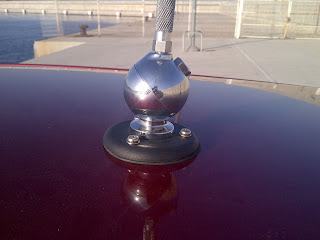
First disappointment was the hustler ball mount I ordered, which is much flimsier than the one I had on the Corsa. EA7JX says Hustler moved their manufacturing to Mexico and a lot of the stuff is slightly changed from what it used to be. Second disappointment was the tin foil like roof of the Toyota, having been used to my chunky old Opel. However the guys who helped me fit everything (Marpi car audio) did find a cross plate underneath the centre and bolted through that but it's still pretty flimsy and I do not want to be putting my screwdriver on it:
Here you can see it with the 17m quarter wave. And yes, it's not quite vertical either....:(
All the rest of it went OK and the basic format is as before, rig connected to the main battery and the amp connected to the back battery. What I did change for this one is that the rear battery is also connected to the alternator, using a relay and a timer. It means that the amp will run off 14V and so put out a few more watts, and a cleaner signal, while lasting longer between charges at home. Sorry don't have any photos of that yet.
So it's great to be back on the air! This week I have a bit more time on my hands and have managed a few more radio hours than normal and it's been great to catch up with lots of old friends and make some new ones too.
First disappointment was the hustler ball mount I ordered, which is much flimsier than the one I had on the Corsa. EA7JX says Hustler moved their manufacturing to Mexico and a lot of the stuff is slightly changed from what it used to be. Second disappointment was the tin foil like roof of the Toyota, having been used to my chunky old Opel. However the guys who helped me fit everything (Marpi car audio) did find a cross plate underneath the centre and bolted through that but it's still pretty flimsy and I do not want to be putting my screwdriver on it:

Here you can see it with the 17m quarter wave. And yes, it's not quite vertical either....:(
All the rest of it went OK and the basic format is as before, rig connected to the main battery and the amp connected to the back battery. What I did change for this one is that the rear battery is also connected to the alternator, using a relay and a timer. It means that the amp will run off 14V and so put out a few more watts, and a cleaner signal, while lasting longer between charges at home. Sorry don't have any photos of that yet.
So it's great to be back on the air! This week I have a bit more time on my hands and have managed a few more radio hours than normal and it's been great to catch up with lots of old friends and make some new ones too.
Subscribe to:
Posts (Atom)