Sunday, June 28, 2015

CAPACITY HATS FOR HF MOBILE ANTENNAS - testing the DX Engineering "Hot rodz"

What is a capacity hat?

Rather than explain it here, you can find a nice section dedicated to Capacity hats at K0BGs website


The goal of todays experiment: see how much a Cap Hat lowers frequency

(As usual, you can click on any of the photos to enlarge them)

I started with a quarter wave on 10m made up of two screw together sections plus the base of the hotrodz sytem :


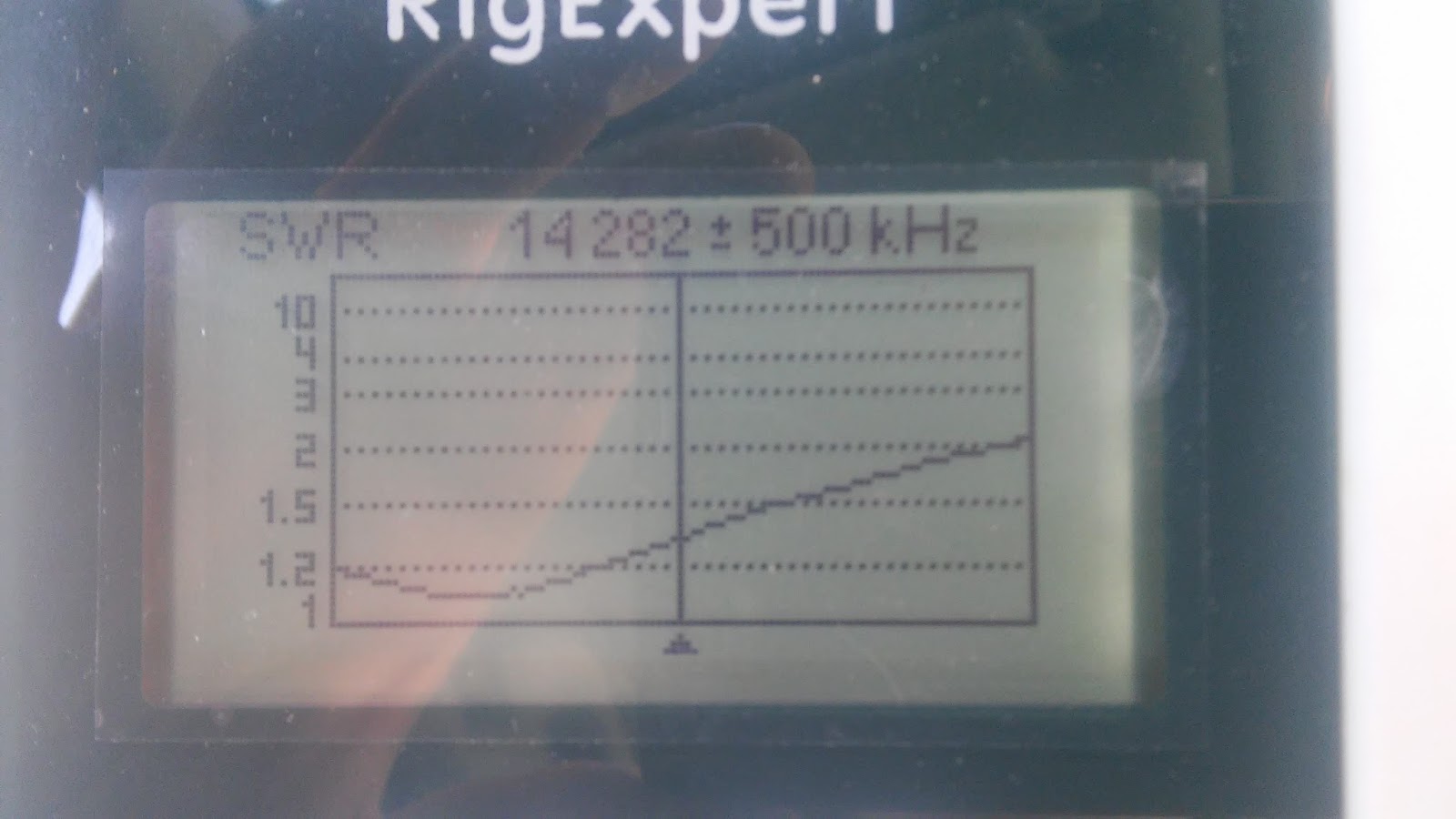
As  you can see below, it was a bit long and resonated aroud 27 MHz, but since this is just for comparison, it doesnt really matter. 


I then added two 24" sections at the top to make a "T" shaped top loaded antenna.


As you can see, it brought the resonance down to 20.4 MHz, a 6.5 MHz drop in frequency.


I then took the bottom 4' section off, leaving the antenna at around 5' long


I ws unable to measure the resonant point since my analyser only goes up to 30 MHz but we can asume maybe 31 or 32 MHz.


The next step was to increase the capacity by installing another 4 24" rods

 
This brought the frequency down to around 25.6 MHz.


To see if I could raise the frequency I tried "shortening" the tips. After a few attempts using trial and error, I shortened each tip by approx 6 " (sorry, I didn't measure them) 

 
 And managed to get this final result


So, am I going to start using cap hats from now on to reduce the height of my antennas without losing much efficiency?
 
The answer in my case is no, and the reason is because of the weight/stability of the antenna system. The mast and hub is heavy duty and makes a pretty top heavy system for using with my puny ball mount on the roof. Not to mention that in my case where the antenna is always installed and taken off every time I park up, this is too long and unwieldy.a process.
 
Where I might use this information is if one of these days in the future I might decide to make a shortened 80m vertical on a spiderpole, for a contest or something. Or, to make vertical dipoles like the old Force 12 Sigma or XR series antennas for using in phased arrays or 4 squares on the dock, where I'd like to keep wire on the ground to a mínimum.


Monday, June 22, 2015

GROUND TUNING UNITS (GTU) IN A MOBILE

To GTU or not to GTU, that is the question.....

Something amiss in the new car?

Over the last couple of years, there have been a number of expeditions active which I needed for a"new entity", but was unable to work. In spite of doing my best to come on at the right time of day, and in spite of trying all the DXing tricks of the trade, I just wasn't making it through the pileup. Many of my local friends were making the contacts, so, I started thinking that maybe something was up with my station. I started suspecting that when I changed cars, something went amiss with the new antenna installation, or that there was maybe a problem with the antenna itself.

Parallel to this, I was reading a lot on the Real HF mobile yahoo group about how people were using GTUs (ground tuning units) to enhance their pedestrian mobile signals. Many of them were reporting good success, and I know that at least one station used a GTU on his car as well.

GTU theory
So, what is a GTU? Well, basically all it is is a device, similar to an Antenna Tuning Unit, which uses an inductor and a capacitor in series to maximise current flow in the radial system and therefore make the ground system less lossy and hence the whole antenna system (radiator+ground/radial) more efficient.

Attempt nº1
My first attempt at trying a GTU system was last year. I purchased an MFJ 931 artificial earth, which in theory does the job just fine. In order to isolate the antenna from the car body, I used a magmount on top of a plastic book binder. I connected the base of the magmount to one end of the the MFJ, and then the other end to one of the bolts on the antenna mount which is grounded to the car body. Result? Nowt. Zilch Nada. Couldn't get a current reading at all, anywhere, anyhow. Thought the MFJ was dud and even though I opened it up and couldn't find anything wrong with it.

Back to the drawing board

More DXpeditions came along and whilst some I was able to work, others continued to elude me. So, back to the drawing board it was.

I contacted GTU guru Dave G4AKC, who is a very well know signal on the bands, either pedestrian mobile or bicyle mobile. Dave wrote back to me to say:

Quote:
The first thing is to ensure the antenna is resonant against a resonant radial(s), this is best done using an antenna analyser and of course with the antenna off the car and the antenna length set to provide 50 ohms at resonance as you would expect. I usually resonate my vertical antennas at home on the top of my flat garage roof, so the radials are elevated and are located about a quarter mile from the sea, however I don't think it will make a lot of difference unless you are in the fresnel range of the sea where we get the enhancement to our signals.
 
The antenna is then refitted to the car and the antenna length is not changed, I know you are using the MFJ-1979 so I guess a mark to identify the length at resonance.
Its essential that the radio is isolated from the car body with regards to an RF path and so the radio needs to be physically kept off the car body and the DC negative line is taken via a simple toroid with several turns of this DC negative line wrapped around it and this is sufficient to prevent a direct RF path back to the chassis. As long as the toroid includes the negative return feed it shouldn't make any difference if you toroid both the + and the -ve lines, however you will need to get at least a couple of turns around the toroid for it to work effectively, so a large toroid will be required! You will have to toroid the amplifier negative line as well, but the clip on large toroids are fine as long as you can get a few turns around them to produce a high impedance path to the car body.
 
The braid of the coax feedline at the antenna end is routed via the GTU, if you are using a mag mount its easy to run a wire from the frame of the mag mount back to the GTU and then returned to the car body.
If you have a bonded mount then of course this needs to be insulated from the chassis of the car.
I usually tune with a low power carrier so as the ground current is at maximum, this current and tuning point alters depending upon location due to different ground conductance as you would expect and of course different settings for different bands, however generally once you have set the GTU for a particular static mobile location the setting will remain pretty much the same every time unless the location is very tidal.
 
You should be able to produce a considerable amount of ground current when near to the sea, I  can get as much as a couple of Amps of RF ground current at high tide with the bike running high power, so you will definitely know when its working properly, the key is to RF block any direct path to chassis other than the GTU path.
 

Unquote
 
Shopping!
 
I wanted to use the hustler mount on the car, so while checking out stuff on the web I came across these wonderful 45KW insulators by Breedlove antenna mounts. By the way these folks do an excellent line in all things antenna mounting.
 
I also thought it was high time to invest in a field strength meter so bought myself a cheap and cheerful MFJ 802 meter . I've read now in so many places that the best way to tell if antenna A or antenna B work better is simply by seeing if the near field is stronger or weaker. There is a great article by G3TSO where you can read all about this and other questions of resonating HF mobile antennas.
 
Attempt nº 2
 
So, once I got all the bits and pieces together, I went up to my house at La Eliana (where I can get peace and quiet, plus a soldering iron near the car if needed).

Before starting, and although most of the tests weren't using the car body, I followed Dave's suggestion about the toroids and snapped on a few to the rig's negative lead.


The first thing I did was try the MFJ 1979 in its usual position, using the untuned car body for earth. Here's how it looked on the analyser for SWR and resonance (reactance X = 0):

(remember you can click any of the images for larger size)


Ok so this looks pretty textbook and to be honest I don't remember that it looked like that last time I put the analyser on it.

The next step was to insulate the antenna from the car, and use a quarter wave radial cut to the exact same size as the radiator


This is what it looked like on the analyser:


OK, so it shifted down a bit in resonant frequency, and so obviously at the higher end we now see the L/C factor creeping into the total R. But still, not bad, and on the trusty FS meter (on a stepladder about 2m from the antenna), no noticeable change at all.

Then, the next logical step was to try tuning the radial with the GTU, so thats what I did:


And hey! The GTU Works! We got CURRENT FLOW!! :)


But you know what? Lower FS on the FS meter. Hmm..... What on earth (pardon the pun).

Here's how it looked on the analyser:


Again, an even lower resonant frequency and obvious departure from resonance (X = 0) the further away we get from the resonant frequeny.

Finally, I decided to tune up the coax that leads up the ball mount. This is what I was ulltimately aiming for, being able to tune either the cable or the body of the car for improved performance over the untuned car body. Well,. I was able to get decent amount of current to flow through the cable, but at the máximum current, the SWR was sky high on the radio's SWR meter. I didn't take any readings on the analyser for this. And also, the FS meter reading was a fair amount lower than for the previous configurations.

CONCLUSION

I am going to retest the "usual position" next to the water to see if it replicates the above readings.

If it does, the conclusión is that whilst GTUs are obviously good for improving performance of small counterpoise trolleys, bicycles, etc., for a larger metal object like a car, there is no advantage to be had. Unless of course Dave G4AKC can convince me otherwise!


Friday, May 01, 2015

NAVASSA - FEEDBACK AND LESSONS

I am a member of GMDX, the scottish DX group. Recently they held their annual meeting, where several DXpeditions gave presentations. One of them was the K1N expedition to Navassa Island. A transcript of the presentation was then published last week in the GMDX digest and I thought it would be of interest to copy the last part of the presentation, FEEDBACK AND LESSONS, food for thought for all of us:
 
 
"Feedback and Lessons

I learn a lot from every DXpedition I’ve ever been on. I’ve put together a summary of my two weeks of operation from Navassa. I’m sure all of my team mates will concur with what I’ve observed and learned.

European stations complained a lot for the “short time” we worked Europe. QUITE THE CONTRARY!!!!

This is a MOST interesting point of discussion! If you look at the times in our logs, we spent MORE
time working Europe than working North America. Our ClubLog statistics, however, show that North
America had 58% of the contacts, Europe 32% and Asia 6%. WHY, then, if MORE time was spent
working Europe, was Europe about half the number of North American contacts???

Simple answer: RATE. Period.

When you listened to us working North America, we could cruise right along at 300-350 Q’s/hour or
more! I have seen the “rate meter” hanging around 500-600 Q’s/hour for some times. (I heard that
someone on the team was clocked at 1200 Q/hour…..on 160M!!!!) When working Europe, we would be extremely lucky to see rates of 100 Q’s/hour. European signals are as strong, if not stronger than North American signals, in the Caribbean. The west coast U.S. is much harder to work than Europe. South American signals were among the strongest!

Here is a note I received after I returned home. It is from a well-known DXer in Europe:

“I listened to XXX working US pile-up on 80m. Fantastic, at least 10 QSO's minute and when he
turned to listen for Europe, the rate was only 10 % of that. Same on the other bands and modes.”
The problem is THROUGHPUT. Rate. Efficiency. Cooperation. Whatever you want to call it.

For the time we spent working Europe, we should have MORE contacts than with North America, but that did not happen. It COULD have happened!

No one more than me would like to have seen the European Q’s outnumber North American Q’s. For
the “next one” I have some helpful suggestions to help DXers, including myself, and particularly DXers in Europe, to be more successful.

Here is what I see are the issues:

1. Not listening to the DX operator

2. LISTEN to and LEARN the rate and rhythm of the operator

3. LISTEN to WHERE the operator is listening and his PATTERN of moving his VFO. You
MUST KNOW where he will listen next if you expect him to hear you! How simple is that? It
is part of the hunt…and the fun of DXing….and getting rewarded!

4. Learn to use your radio (split/simplex, etc)

5. Do NOT jump to and call on the frequency of the last station worked. The DX station will
NOT hear you because the din is total unintelligible chaos. Move UP or DOWN from that
frequency, as we on our end were continuously tuning up or down after each Q, so if one jumps
onto the last-worked frequency, we will not hear you, even if you were the only one there, as we
have already tuned off that frequency.

6. TURN OFF ALL SPEECH PROCESSORS AND COMPRESSION! Do NOT overdrive
ALC. There is a night and day difference in listening to NA/AS and EU pileups. The horrible
distortion makes it impossible to copy many, if not most European callsigns. I don’t know what
it is, but I would bet that mike gain and compression controls are “firewall forward,” all the way
clockwise. There were MANY loud stations that we did not work, COULD NOT WORK, simply
because we could NOT understand their terribly distorted callsign. Have you ever listened to
yourself in a pileup? We gave many stations a “19” signal report. Very loud, but extremely
unintelligible! You want to have INTELLIGABILITY, not distortion!

7. Give your callsign ONCE and ONLY ONCE! DO NOT KEEP CALLING! Call. Listen.
Call again if needed. Listen. Listen. We would tune on by those who did not stop calling.
We are looking for RATE and getting stations into the log. You should be, too!!!

8. If the DX station comes back with your callsign, DO NOT REPEAT YOUR CALLSIGN, AS
WE ALREADY KNOW IT or we would not have answered you. Many stations (in all modes)
would repeat their callsign two, three and even four times or more! This was so frustrating at
times that we would just move on to the next station. We ONLY want to hear “5NN” or “59”
from you. Anything else is a total waste of time. Let me repeat, if we come back with YOUR
callsign, DO NOT REPEAT it back to us! (Did I repeat myself?.....forgive me!) It CHEATS
others out of a chance to get into the log. Only repeat your callsign if it needs correction, and
then let us know it is a correction. Anything else is cheating others out of a contact. Others are
cheating YOU out of a contact! Our propagation windows and time on the island are limited
and we need to maximize the opportunity for everyone. SPEED and EFFICIENCY ARE OF
UTMOST IMPORTANCE!

9. LISTEN to the DX station come back to someone. IF THERE IS NOTHING CLOSE TO OR
RESEMBLING YOUR CALLSIGN……SHUT UP! SHUT UP!!!!! This needless interference
slows things up and lessens YOUR chance of getting into the log! We are focused on the
callsign we heard and do not hear you, only your QRM’

10. Take some time to listen to the next DXpedition working North America and listen to the rate
and rhythm of the operator. It is fast, quick and efficient, and more people get into the log!
Then listen to him work Europe. The wise operator will catch on quickly to what it takes to get
into the log!

11. SPREAD OUT! Our highest rates (for any continent) were working the center and far edges
of the pileup where there was less QRM. Weak stations were much easier to work than loud
stations in the middle of the pileup. If we say, “Listening 200 – 210,” 70% of the pileup sits
exactly on 200 in an unintelligible din, 25% of the pileup sits on 210 and is almost as bad. 5% of
the pileup will be spread out somewhere between 201 and 209, making them very quickly put
into the log. S P R E A D O U T ! ! ! ! Dare to be different! Dare to be heard!

12. LOUD is NOT better! MORE AUDIO/COMPRESSION is NOT better! Finding the spot to
be HEARD is the MOST important thing you can do to get into the log. My biggest thrill (and
I’m sure on both ends) is finding the lone weak station and getting him into the log quickly.

13. LISTEN to the DX operator INSTRUCTIONS! As we would constantly tune our VFO, if
we find a clear spot, we would often say, “33” (meaning for YOU to transmit on 14033, 28433,
etc). A few would listen and get into the log very quickly. You cannot hear these hints if you
keep calling calling calling calling……… Many times I would say, “listening 200-210” and
after a while would say, “listening 240-250”. Often 30-45 minutes, even and HOUR later, I
would find MANY still calling on the original “200-210”…..of course, they would never show up
in our log, as I was not listening there. LISTEN, LISTEN, LISTEN and LISTEN SOME MORE.
The less you transmit, the better chance you have of getting into the log. You must know where
I am listening if you really want to get into the log.

14. LISTEN to the “good” guys to make it into the log. Study how they do it! It is not easy to
find the “good” guys, as they are quick and efficient and are in the log and gone, long before
anyone can find them. They don’t transmit much. They are listening.

15. LISTEN to the “bad” guys. It won’t take you long to find them. They keep calling and
calling. They aren’t listening to find out where to transmit or they wouldn’t be calling. How
simple is that? Being LOUD helps, but not if the DX is not hearing you!

16. If you don’t want to get into the DX log, just ignore the above suggestions, and keep calling,
calling, calling….. I wish you the best of luck. You’ll need it."

Sunday, April 19, 2015

PLEASE RESPECT MY CQ DX CALL

I never thought I'd need to post this but in view of what I'm hearing on the air these days, perhaps it's not a bad idea.

What is DX?
As far anyone can tell, the terms means "distance X", and in modern day English has the equivalent of "LONG DISTANCE". Now, its clear that this term is subjective and not the same for everybody. Long distance on uhf is not the same as on HF, for example, nor is it the same for someone running qrp and simple antennas as someone using a more sophisticated setup.

In order to qualify what DX means, it was established in times well before I was licenced that DX on HF is a station on another continent. This was, and is, the definition I and millions of other hams understand and accept.

However, in view of the fact that it seems a large number of hams might never have had this fact clarified, I think it's time to set the record straight, even if it is only on a little-read and uninfluential blog.

IF YOU HEAR ME CALLING CQ DX, I AM LOOKING FOR CONTACTS ON ANOTHER CONTINENT. PLEASE RESPECT ME.

Now, it may well be that you are in Europe and want to give me a call for some reason. You might want a qsl from my province, you might want a rig check, or you might be a friend wanting to say hello. Does this mean you shouldn't call me? No. What it means is the following:

Please listen.

If you hear me working another station, please don't call.

If you hear me call DX but don't hear anyone come back to me, please don't call. There may be a weak DX station calling me that you can't hear. If you call at the same time, I will need to ask the other guy for a repeat.

If you hear me call more than once with no apparent reply, give me your call. If I don't reply, please don't insist.

If when giving your call you say something like "not dx but would like a short qso/antenna check /etc" there's a good chance I will reply.

If I do reply to your call, please keep it short.

I'm sure that at this point a number of readers will be indignant at my attitude. Please take into consideration the following:

My operating times are usually short. I am a busy man with a demanding job and with family commitments. I do not have all day to chat on the radio (I wish I did).

I live in a country that is the fifth least wanted on the dxcc list. In the event that you do need Spain confirmed let me know and I'll be happy to send you a card.

I do not always call dx. There are times when I am looking for a chat with anyone anywhere.

I don't always operate from a dx capable station and know what its like to be qrp or antenna limited and the only guy you can hear on the band is looking for dx. As you can read above, respect my call, if no one comes back after a couple of times then go ahead. I am sensitive to things like qrp, portable, and novice licence holders.

To recap:
For those who are unaware of what dx is, on HF it's contacts on another continent.
For those who think their need for a qso is more important than what I want, time to revise your operating. I am not a bad operator for not answering you. You are a bad operator for calling when you shouldn't.

Please feel free to comment if you I'm wrong!


Saturday, January 31, 2015

MFJ 1979 telescopic whip


This entry is an update to the info already published about MFJ telescopic whips at this link

Basically, the MFJ 1979 is the logical extension of the MFJ 1977: the same improved quality and design of the 1977, but in a 5 metre (17ft) long version. This way, in one simple whip which you can put in the back of your car, you have an antenna that will work all bands from 20m to 6m, when telescoped out to the appropriate length.

Any comments to make regarding this new version? Well, I've had mine for about 18 months, average use several times a week so you can calculate its been telescoped up and down some 300 to 400 times. A couple of weeks ago on 20m I noticed that SWR had jumped up slightly, and after a bit of head scratching, I noticed that one of the sections had loosened up a bit and had slipped down into the one below. After a note on the "REAL HF MOBILE" yahoo group, it seems like many users of this antenna have had the same problem. The quick fix is a bit of insulating tape on the offending joint, the more permanent fix is apply some pressure with pipe tools or similar to make the joint stiffer again. Like the 1954 and 1956 models, life expectancy is not great, but at around 70 euros, I think its probably still worth it.

Performance wise this is like the other whips, it works very well and I have been able to net lots of good DX worldwide, including a couple of New Ones.

I bought mine at WIMO but they are also available now in Spain at ASTRO RADIO.

Happy mobiling!

A couple of strays

A wee rhyme I read on LA1BNA's QSL card (tnx Svein):

"The QSL, the holy grail,
The DX'ers joy that comes in the mail,
And though we prize these souvenirs,
It sure takes long - it seems like years!"


And now, check out the reason for KH6CB selling his radio!:

RADIOHF - FOR SALE; Kenwood TS-590S
Purchased from AES on 2-20-2013. Factory upgrades already done. Serial #B3100061. Bought this rig as back-up to my IC-7600. My amp blew-up when without knowing a 4 inch lizard got inside my amp and was laying on a RF coil. when I turned power ON, sparks, flame and smoke erupted from amp. Not only was lizard cooked but his intestines was splattered around the coil. Therefore - - I need cash to buy a new amp. $1300 + shipping (from Hawaii). Postal Money Order only. Thanks for looking SONNY KH6CB P.S. Absolutly NO issues with this rig. Still new condition. Approximate air time 20 hours.

Monday, October 27, 2014

CQWW SSB 2014 EA5ON

CQ Worldwide DX Contest, SSB

Call: EA5ON
Operator(s): EA5ON
Station: EA5ON

Class: SOSB/10 QRP
QTH: Vilamarxant
Operating Time (hrs):

Summary:
 Band  QSOs  Zones  Countries
------------------------------
  160:
   80:
   40:
   20:
   15:
   10: 1352    34      116
------------------------------
Total: 1352    34      116  Total Score = 484,950

Club: EA Contest Club

Comments:

For the last 6 years I have operated CQWW SSB as part of the ED5T multi single
team. We love this and have a great time putting on the show.
This year however we had a serious problem right after ARRL phone. One of our 3
towers came down in a storm, bring down our 2 element yagi for 40, our 2 x 4
element stack for 15, and the base of our 160m inverted L. Our team, including
myself, are very busy doing other things right now and the tower is still not
back up yet. So, no antennas for multi single.

In the meantime, my good friend Paul GM0OPK, who has a house near Valencia,
asked if I would be interested in using his newly installed 6 element ultrabeam
in a contest. He is not a contester but wanted to see how his station would
play. I thought about it and since I have been thinking about doing a Single Op
entry for a while, decided to accept his kind offer.

Paul's station is not designed for contesting. It has one single yagi, a TS990,
and an OM2500 amp. Its principally used for DX and ragchewing when he's here in
Spain while taking time off work. I decided that the best way to use this
station for a contest would be in QRP, where I could use the high gain beam to
make up for my very low power, plus use the dual receiver to enable me to call
CQ while doing search and pounce on the second receiver.

Paul was here a month before the contest and I went up one afternoon to discuss
what I would need. I took up a new Yahama CM500 boom headset, which we set up on
the Kenwood, and decided that all I needed other than that was my laptop with
the N1MM logger installed.

A week before the contest Paul texted me to say he hadnt been able to find any
flights but was still looking. I started thinking of Plan Bs but thankfully on
the Tuesday he managed to book tickets and on the eve of the contest I drove up
after a long day at work, set up the PC, moved the furniture a bit, and went off
home for dinner and bed.

A 6am start on saturday, only to be greeted by Paul with bad news: the
Prosistel rotator was acting up and there was no way to get the controller to
tell you where the beam was heading. He had tried in vain to control it with
the PC program but to no avail. So, I turned the antenna while Paul was outside
watching it and when it was pointed on EU, he called me to stop and we left it
there.

A very slow start as usual. Worked a few east med stations and then after a
long and frustrating time of having a VK6 call CQ in my face, finally managed
to make the contact. Then the band started opening and I was able to work UA
and JA stations for a couple of hours, all on S+P. I found out after trying to
call a few double mults in vain that the antenna wasnt where I thought it was,
after that every time I used the rotator I went outside to check the beam
heading visually. Only a few degrees can make a fair difference on a 6 element
antenna so even the visual method wasnt great. Then, an hour later as I was
trying to use the quick reverse feature, the stepper motors got into a fuddle
and started an interminable cycle of changing back and forward. I couldnt get
the controller to respond so ended up pulling the plug and then doing a reset
of the whole thing. It worked fine after that but no idea what had caused it.

At midday I had a couple of hundred QSOs in the log and a number of zones and
countries but missed out on a lot of mults just not able to get through the
pileup with 5w. However when the band opened to the states it was quite a
different story. I was able to work everyone I heard, many on the first call. I
tried running, no real luck until around 7pm when all of a sudden I managed a
run to the US for about an hour and a half. Not the rates I'm used to at ED5T
but I still managed to leave when the band died with 678 qsos in the log and
188.000 points.

At night, I checked the spanish record and saw it was at 852 qsos and 319000
points. Its also the EU record. In spite of my good qso total, the record
holder had managed 34 zones and 137 countries back in 2002 and I was a long way
away from those totals.

Sunday morning was pretty much a repeat of saturday but having the beam under
control meant I was able to work double mults such as VU2, AH2R, and 9M4DX,
plus a few other countries. The band was so crowded that I'm sure many
potential countries were buried in the noise. Running assisted would probably
be a good thing under conditions like that, maybe next year? But S+P was
slower, I had already worked most of the big guns, and had to dig deeper into
the QRM for contacts which then took longer to complete. By lunchtime my score
had crept up a fair bit but was still not close to the record. However once
again in the late afternoon conditions picked up to the states and I was able
to end the run well over the previous record. After a short rest and some food
(I hadn't eaten in 10 hours) I took a tour up and down the band to work all the
south american stations I could hear, adding another few mults to the total.

This contest was a complete and absolute contrast to the last time I tried 10m
qrp in a contest, 2 years ago in ARRL 10m. In that contest, I couldnt make any
contacts at all with 5w, changed to LP, and abandoned after only working 50
stations during the saturday. The conditions this weekend were simply fabulous,
I'm sure the best I've ever seen 10m and probably will take a long time in
seeing again.

Thanks as usual to all that made it happen. For all of those who took the time
to pick my signal out of the noise. To the family for not missing me too much.
And most of all, to Paul and Tracy for coming down and hosting me in such a
great way, it is really and truly appreciated.

Saturday, June 21, 2014

Update

Last entry in February, uff. Does that mean I've not been playing radio? No, but means I've not had much time to do any updating. And actually, less time to play radio as well.

The first event after my last entry was my participation in ARRL SSB. I entered 15m HP and had an absolutely amazing time, working over 2000 stations and only missing 3 multipliers (the usual Canadian ones). I had a good head to head race with EA7KW down near Seville and while he pipped me to the post in the end, we had a great time.

However the sad news is that 3 days after the contest, the 80' crank up tower holding the 15m stack and the 2 ele yagi for 40m came crashing down in a storm. No damage to persons or property, and the tower will be salvageable, but the antennas are complete scrap. Juan has done a good job on repairing the tower and we can get around 70' of it to be serviceable again, but for the time being we have no antennas and the tower is not installed back on its base. It has come at a time when all of the TCC members are very busy with other things in our lives and we just haven't had the time, energy, or inclination to do anything about it. Such is life.

As far as the IARU contest goes, we have decided that since we can't take part on 15m, we will take part in 10m SSB instead, since the 10m stack and the optibeam are still working perfectly. We look forward to operating as part of EF4HQ on 10/11 July. Propagation of late has not been good on 10m but we are holding our breath and crossing our fingers just in case :). No other hints as to what EF4HQ has in store, but we are going all out this year to win the HQ category after two years of second place.

In the car, no news ones worked but I did get Myanmar confirmed. My new working hours mean that I cannot come on the radio at lunchtime any more, however I do finish work a bit earlier and in theory will get radio time after work. In practice I am never managing to finish work on time and getting a bit fed up of the situation. Lets see what happens. Today I did manage to get 3 hours of morning grey line operating done, conditions were pretty good considering today is our summer solstice and that the SFI is not particularly high.

As for new antennas, I started a project of comparing different types of vertical antenna and radial systems. However I am finding inexplicable problems to get some of the quarter waves to work and also the GTU is functioning very erratically. More news on that front if I ever get there.

On 20M I have a new antenna which arrived 6 months ago and still haven't had a chance to test. This is a high power end fed vertical for 20m made by the dutch firm http://www.hyendcompany.nl/ . The idea is to hold it up using a 12m spiderpole from Spiderbeam with a base made by a couple of local guys in EA5 which fits under the car wheels, specially adapted for the spiderpole. Lets see if I get a chance to test it out one of these days.

I also received another "new toy" the other day, a four square controller by Comtek, now run by DX engineering. This will need four new 15m verticals, plus I need to cut all the control lines, so it won't be on the air for a while yet I reckon. But looks very promising for 15m contesting from the port!

And the last new toy, received about 10 days ago, is an Elecraft KX3, a great little software defined radio with almost everything incorporated inside, for easy low power operating while out and about. I bought it primarily for the bicycle, but it's first outing was last week for the anual DVGE trig point contest. I worked around 50 stations on 40m just running 5w and a vertical, not the best antenna for local 40m work but its what I had. It'll take a while for me to get used to all the possibilities this rig has to offer but my initial reaction is very favourable.

No photos of any of this stuff. My trusty old BlackBerry has been pensioned off and I now have a Windows phone, which I haven't even tried to plug into the computer yet to download pics. Maybe later.

And lastly, in reply to a petition from German ham Marcel DF1MP, here's a parts list for some of the pieces I use on the car:

Hustler ball mount for the roof: http://radioshop.hamradio.es/es/bases-de-movil/190-hustler-ssm-2-soporte-de-bola-reforzado.HTML

MFJ 1664 screwdriver: http://wsplc.com/catalogsearch/result/?q=1664

MFJ 1979 long telescopic whip:  http://www.wimo.com/mobile-antenna-hf-various_s.html

I guess there are more places too.

That's all for now folks....

Sunday, February 23, 2014

Receive antenna experiments at ED5T

This weekend is the CQWW 160 phone contest. With one thing and another, we decided not to actively operate in the contest. However, Elías EB5KT and myself arranged to go up on Saturday night and take advantage of the fact that there was a contest on, in order to do some RX antenna tests.

ED5T is at a great location for the high bands. Our stacked yagis for 10 and 15 metres do great, as does the tribander for 20. We are at the top of a ridge with a nice drop off to most areas of ham population. However, on the low bands, we do not have enough height for good horizontal antennas, the ground is poor for vertical antennas (mostly bedrock), and it is extremely noisy on reception.

For transmitting, we now have an inverted L for 160m, which appears to work, but we don't really know since we have a very high noise level and can't really tell who is calling us. In the past, we have tried the K9AY design, long terminated beverages, and the flag. None of these antennas gave particularly good results. The K9AY was forcibly located near to a metal fence which we think probably degraded performance. The beverages perhaps didn't work too well since local terrain dictates they can't go perfectly straight, nor at a fixed height from ground all along the antenna. Also, these antennas need to be installed before each contest, and for the beverages in particular, hauling two 500m long antennas through the forest and then attaching them to trees is not a load of fun. Whilst both designs work, they do not provide a significant improvement over the transmitting antenna and therefore we continue on our quest for a design more suited to our needs.

One of the tests Elias wanted to do was to use a portable receive antenna to try to find out if there are any locations close by which are better than others, either in noise level, signal strength, or both. In order to do this, he made a monoband Shielded Loop antenna for 160 on a portable pole. We used an FT857 radio with a small battery in a backpack and started testing in different locations.


The results were very interesting:

- We stopped in around 15 different places and tested for noise reduction by turning the loop.

- In most places we stopped, by turning the loop we were able to obtain a null in the noise and except when close to buildings or right under power lines, we could usually reduce from between S7 and S9 peaks down to S0 noise

- We could not pointpoint a particular direction for the noise. In some cases, only moving 10 metres produced a 90º difference in the null location. We are unable to account for this.

- In the case when listening to a frequency occupied by a station calling CQ, in most cases the noise null did not coincide with a reduction in signal strength of the station calling (máximum signal to noise ratio).

- When listening to ED5M, we were able to hear about half the stations they were working. They were using a full size 2 element delta loop at 50m (150') high for TX, plus numerous 650m long beverages and a K9AY, in an electrically quiet natural park about 100km from us.

- We sat the antenna on the top of my car and plugged into my TS590. The absence of noise made the fatigue factor usually present, neglible. It was almost like working on 10 metres. We were able to hear a large number of contest stations without any problem.

The results are not conclusive since we did not use any know reference antenna for comparison (rule nº1 of basic science). However our experience dictates that this was a positive experiment and worth pursuing. For next weekends ARRL contest, Elías hopes to have a Pennant antenna built and install it at one of the locations we found to be good, and that is reasonably close to the shack.


Sunday, January 26, 2014

Visits to GM1DSK and GM0GAV

Whilst over in Scotland over new year, I made my usual pilgrimage to visit my Elmer. His call is GM1DSK, but to me, has always been Meeeeeester Steve! Steve is as active as his other commitments allow him to be, and up until now using a 100w and all wire antenna station. As luck would have it, Steve just recently got a 30' tower, a 3 element tribander, and a 3 element dual band warc beam, and the day I went to visit, it had just been installed and up and running:


Although in the photo it doesnt look too high and has tres around it, what you can't see is the nice dropoff to many of the more interesting DX áreas, as the QTH is on a clifftop with a river below. When we went to get on the air and see how it was working, Steve stumbled across 1A0KM, an entity he hadn't worked yet. Here's the moment of glory as Steve gets another "new one" in the log:


Next on the whistlestop tour, Steve drove me across to Gavin GM0GAV's place. I hadn't seen Gavin since the days when he worked in the Antartic as VP8GAV, and it was great to see him again. I knew he'd built up a good station but I don't think I was prepared to see such a level of workmanship or such a well thought out design. In the shack is nothing special, but the purpose-built house on a 4 acre plot took antenna placement into consideration at inception, something most of us can only dream about.

The first antenna you notice as you drive up is a relatively modest force 12 XR5 on an 18m high crankup tower, with a 5 element 6m yagi on top.


But as we came along the driveway, I noticed a couple of verticals laying on the ground. We then went out and had a look and it turns out to be a 2 element phased vertical on 80m. The whole field has an extensive radial system laid out under the grass. Each antenna is on a pulley system so that they can be lowered in case of high winds.


Once parked in front of the house I noticed another tower, wound down, with another HF yagi on it. This is a motorised korean made tower which goes up to 28m high and is crowned with an Optibeam OB12-4.

 
For top band, Gav uses an inverted L with elevated radials.
 
There are also 3 250m long reversable beverages, conveniently installed along field and road boundaries.
 
The whole system is controlled from a central switching system in a small shed in the garden.
 
My thanks to Steve and Gav for their time and for the guided tours (not to mention food, tea, and coffee!). CU in the pileup!!


Sunday, December 01, 2013

SALT WATER BEAMS: Where to go from here?

As previously reported on this website, experiments with centre fed two and four element beams have been done on 10 metres with some degree of success. The design is easy to set up and can be rotated without a huge degree of difficulty and does give some gain, all important factors in my operating. I also tried a two element phased switchable end fire-broadside array with inconclusive results.

However, those antennas have some issues, namely:
- The centre fed design gets to be pretty big for lower bands, requiring bigger supports and/or guying.
- The coax feed did not give me much confidence, difficult to keep it coming off at a right angle, and "hot" mic was a sure sign of common mode currents on the outside of the coax cable.

Since those experiments last autumn (2012), I have been thinking about different options, that might keep the good points of the centre fed designs, and overcome their issues. When considering antennas, I consider them for two different kinds of use. One is for "working a new one". For this kind of use, I put more weight on a quick setup, high gain antenna, and less weight on rotatability.

Parallel to that though, I was also wondering how much of a difference there was between setting up a 3 element yagi and two x two element phased yagis. I asked Elías if he could do the simulation for this one for me and this is what he came up with:


His conclusion is that the 3 element yagi is probably a better choice, giving a broader pattern, easier installation, and only a fraction less gain on the main lobes.

END FED DESIGNS

I have used commercialy made end-fed antennas with some success, both at my mountain house in EA1 (on 20m) and also portable (on 10m). After the difficulty installing the centre fed two element phased beam, I looked at the possibilty of using end-feds for this.

I mentioned this on the air one day to my friend Jim ZL1BOS, who suggested I contact KH6MB Martin, a gentlemen he'd met on his travels in Hawaii and who used end fed beams by the water there. As luck would have it, that very same day Martin answered one of my CQ calls and we talked briefly about the matter. I zipped off an email and got some info back from Daryl W7TAE but never did get all the information I needed. However there is a nice pic of Martin's variable matchbox kit at http://ham.aditl.com/ham-radio/techie-stuff/efhw-tuner/ and some nice photos of their setups on the KH6TE QRZ.com page

The nature of end fed antennas, with high impedance feedpoints, worried me with possible problems with common mode currents, so I had a look to see what W8JI had to say on the matter. And basically he says that while these antennas can be made to work, there are significant possible problems. Since these antennas are often used QRP or low power though, the symptoms at this power level are often not appreciable and therefore go unnoticed. You can read the full story here.

So, although I haven't completely discarded the endfeds, especially thinking of low power and perhaps phased antennas on the higher bands, the end fed is not without its problems.


ROTARY YAGIS

When considering possibilities for a fixed antenna on a tower, in the case that one day I might be granted permission to do this at the port, I thought about rotary vertical yagis, using the same design criteria I used for my fixed centre fed yagis, but set up like a traditional yagi, the only difference being that the elements are vertical instead of horizontal.

The 2 element design was quite easy to make, using the MFJ 2299 as the basis for this. It could be set up quite easily on a mount like the one I used for the 2 element quad for 15m:


The two-dimensional design of the yagi would make it much easier to install, I could use a rotator, it wouldn't be too hard to change bands, and it would be easy to tune each element with the analyser and then short out the reflector just by screwing in a shorted PL connector.

One of the disadvantages of this system is that it can only be either 2 or 4 elements, since a 3 element design would put the bottom part of the centre element right next to the metal mast. 2 elements is maybe not enough gain, 4 elements is starting to stretch the mechanics of the thing. I couldn't think of a suitable non-conductive support, so I asked on eham just how much the metal mast was change the pattern in any case of a 2 element design. A kind person modelled this for me and you can see the difference here . It shows a significant distortion of the pattern which whilst not making the antenna unuseable, does mean I should probably keep thinking about other options.


TRAILER TOWER / TRAILER YAGI

If you're wondering why I'm not considering using the quad in the photo, it's because the setup is really difficult. However I did look at the option of using a trailer tower for this. I guess there are more manufacturers, but the ones I was looking at were made by Tennamast , a good scottish company :)

Whilst looking at the trailers, and seeing if there was a local manufacturer who might do something similar, it struck me that I might be able to use a trailer as a basis for a three or even four element vertical yagi. But instead of being a vertical dipole design, it would use the "vertical with two elevated radials" design. This way, I could overcome the metal mast problem. And being on a trailer with wheels, to rotate the antenna was a simple matter of turning the trailer round.

I really like this idea. It makes for a really quick setup, since much of the hardware can be left assembled on the trailer and its a case of installing some pre-assembled elements and away you go (a very important aspect for me).

What has made me decide not to go for either of the trailer options in the end is a practical problem of where to store it! In my underground car park at the home QTH there is no space. And whilst I could keep it at my QTH in La Eliana during the Winter, I'd need to move it for the summer for when guests come to the house.

MY CURRENT "BEST IDEA"

As a "variation on a theme", I reckon I can probably make the "vertical yagi with elevated ground planes" work on my car, placed on a roof rack or ladder rack. At first sight it sounds like something that our 11m cb brothers use, but from what I can tell, their installations don't seem to be very well optimised and looks like they get more benefit out of their 10kW amps than the antennas! Installation would not be as quick as on a trailer, but I reckon with a bit of careful thought and planning, I will be able to make this work.

I already tried a basic version of this (see http://www.ea5on.com/2012/11/more-on-2-element-vertical-beams.html) but neither element used tuned radials, nor was the spacing optimum, which would lead me to hope that a properly installed one should work better.

 At this moment in time I am sourcing parts if I don't come up against a "DUH I hadn't thought of that" moment, this will sooner or later become a reality.....watch this space, but don't hold your breath!


Saturday, November 30, 2013

EA5ON CQWW CW 2013

CQ Worldwide DX Contest, CW

Call: EA5ON
Operator(s): EA5ON
Station: EA5ON

Class: SOSB(A)/15 QRP
QTH: Valencia
Operating Time (hrs):

Summary:
Band  QSOs  Zones  Countries
------------------------------
  160:                   
   80:                   
   40:                   
   20:                   
   15:  351    28      100
   10:                   
------------------------------
Total:  351    28      100  Total Score = 93,056

Club: Torrent Contest Club

Comments:

Wow! What a fun time!

I am an almost exclusively phone op and only started very low-key CW contesting
in 2010. This year I hadn’t taken any decision about CQWW until the Thursday
evening when I decided I would once again do a s+p QRP monoband effort. I also
decided that since I hadn’t done any practice in the last year, and hardly
any CW DX QSOs, it would be a good idea to go assisted. Normally I don’t use
the cluster for SO phone contesting but for this event it would probably reduce
my busted calls a lot and help me out a bit. It looked like I had an SWR
problema with the antenna and was all set to do 20m but a niggling thought made me take
the amp, ATU, and low pass filter out of line and test directly at the rig.
Bingo! Low SWR, so I decided on 15m. I downloaded N1MM to my new PC, did a half
hour session on Morse runner, and went to bed.

Saturday looked good to start off and I managed to make a good number of QSOs,
once I remembered how to send my call and check the cluster calls were OK. No
CAT from computer to rig, so I had to tune the rig manually to the spot
frequencies and do all the sending with the paddle. After a while I tried CQing
at the top end of the band, but following a couple of disastrous attempts at a
QSO I decided to revert to s+p. There were lots of calls not on the cluster but
a lot of those ops were so fast it was impossible for me to copy, so I decided
to concentrate on getting multipliers. Some of the pileups were pretty tough
and no way to break the KH0 or KH2 piles, I could also hear KL7 but didn’t
even attempt it. Slowly the count kept creeping up, but unlike other contests,
very few USA stations spotted. At evening mealtime the band was dead, a quick
check revealed a half time score of 178 qsos, 22 zones, and 73 countries. This
was already better than my best previous score. After dinner I decided to take
a spin round a dead band and was rewarded with multipliers from HK and Z8.

Sunday I decided that it would be hard to pick up many more multipliers with my
puny 5w and decided to try to work the bandmap a bit more intensively. At first
most eastern stations did not copy, with their beams all towards JA, but slowly
but surely the band opened up a bit and I was able to get a few in the log. I
was also able to work Japan, China, and Mongolia, all for double mults. As we
were sitting down for lunch I saw a spot for VK2IM pop up and I tuned to his
frequency, there he was and no pileup! But the dirty looks from the family put
paid to that and by the time I got back, he was gone. Another afternoon without
much in the way of spots so I ended up using my ear, who knows what my busted
call rate will be for those ones. I managed to break a few pileups for mults
like Iceland, Greenland, and Isle of Man, but no such luck with Jersey,
Shetland, or Crete. Once the band was almost devoid of stations I tuned around
again and to my astonishment a barely audible 9L1A pulled me out of a pile for
country number 100. I then tried for ZF1A but no such luck and finally after
working a few Brazilian stations, called it a day.

I realized after doing this that I could have tried using skimmer/RBN for this,
as a phone op I forget these things exist! This might have helped me boost my
score. I also continue to be amazed at the skill of so many ops who were able
to pick my 5w signal out of the noise over and over again. I take my hat off to
these people, hardware helps make a big score but in the end these guys are
just super ops and I congratulate all those who made a big score through their skill
and effort.

Thanks to all for the QSOs.

Rig: IC765
Pwr: 5w
Ant: Optibeam OB6-3M

73 de Duncan EA5ON

Thursday, November 07, 2013

ED5T CQWW SSB 2013

The link is posted on the contesting page too but here it is again:

http://www.3830scores.com/showrumor.php?arg=kJaRzLfcmamiX

The video:


And the spanish extended text:

Por fin llegó la hora de la verdad, la prueba del algodón: CQWW! El momento de poner en marcha todas las mejoras de la estación para ver si todo funcionaba en su conjunto.
 
ED5T tiene su QTH en el alto de El Vedat (Torrent). Es desde luego un lugar privilegiado para hacer radio, y no es por nada que allí estamos rodeados de torres de radiodifusión, televisión, y telefonía. Para una estación de concursos de HF tiene una ventaja adicional, que es la caída brusca del terreno hacia el norte. No obstante, tener una estación de estas características no está exento de problemas. Al pertenecer al ayuntamiento y estar cedido a la STL de URE, estamos sometidos a una serie de restricciones en cuanto a qué antenas podemos montar y luego mantener. Y, cada vez que hay que hacer algo, tenemos que desplazarnos de nuestras casas. Esto quiere decir que muchos de los trabajos se hacen contrarreloj y no se puede hacer pruebas exhaustivas. También quiere decir que algunas cosas se tienen que montar de forma provisional cada vez que hacemos un concurso.
 
Durante el último año se han hecho bastantes cambios. Es cierto que la yagi de 40m se había probado bien en el concurso de la ARRL, y después de hicieron unas mejoras en base a los resultados. Las dos antenas para 15m se probaron bien en el concurso de la IARU y funcionan correctamente. Pero teníamos las antenas nuevas para 10m que no se habían probado apenas, y también la L invertida para 160m que no se había hecho ni un solo contacto, solo habíamos comprobado el ROE. Los juegos nuevos de stubs para combatir la interferencia entre las dos estaciones se había hecho esta vez meticulosamente usando el mini-VNA y mostraron un rechazo muy bueno, pero se habían montado en su caja el miércoles antes del concurso y sin hacer ninguna prueba de si funcionaban o no. Un año más, habíamos decidido montar antenas de recepción tipo Beverage. Esto implica montar dos antenas muy largas a poco altura, en un bosque donde hay senderos y pueden pasar personas, bicicletas, y hasta caballos. Se monta a última hora, y como siempre, nos pilló el toro, poniendo las picas y coaxiales con linternas, todo el mundo sudando y jurando.
 
Con esto quiero decir que aunque a priori una estación de este tipo tiene buena ubicación para radio, normalmente llegamos todos muy cansados antes de siquiera empezar a operar. Por lo menos este año hemos introducido un elemento lúdico que es la barbacoa antes de empezar el ´test.
 
Arrancamos muy bien. Yo me había ido a dormir y al venir a las 7 de la mañana me encontré con Victor EA5KV. Primero me contó las buenas noticias, que en lugar de quedarse en las bandas bajas, se había quedado en 20m haciendo running de americanos casi toda la noche. El horario ponía que se turnaba con nuestro invitado Andreu EC5AA pero Andreu quiso quedarse haciendo multiplicadores y la verdad es que los dos hicieron una noche memorable, ayudado por Elías EB5KT y Juan Carlos EA5UF. Las malas noticias, que nadie le había dicho a Andreu que el rotor T2X en torre 2 se engancha con frecuencia y que no se debe acercar a los topes por si se enganchaba allí. Tuvimos la mala suerte que pasó justamente eso y se nos quedó la yagi de 40 mirando hacia el este y la yagi de 15 mirando hacia el sur. Intentamos arreglarlo de noche y a lo bruto, pero no funcionó. Afortunadamente Andreu pudo encontrar una solución y cuando era de día ya giraba todo otra vez.
 
En ese momento, parecía que la meta que había propuesto quizás se podría alcanzar. No obstante conforme iba pasando la mañana, se nos iban disipando las esperanzas. Nos costaba mucho mantener buenos rates en 10 y en 15 metros, a pesar de tener un SFI de unos 160. Al parecer, la buena propagación se había quedado más al norte, y aunque pudimos trabajar bastantes multiplicadores, no entraban una gran afluencia de corresponsales, ni de Asia ni de Europa. Por la tarde cuando ya debían estar entrando USA con fuerza, notamos otra vez lo que había sido la tónica de la semana anterior, que era la banda abierta hacia el este hasta bien entrada la tarde, con algún americano intercalado, y luego sobre las 6 de la tarde, alguien abrió la propagación a Norteamérica de repente. En este sentido fue de gran ayuda tener este año los stacks, pudiendo trabajar en dos direcciones a la vez, y luego tener más zona de USA abierta al mismo tiempo.
 
Por la noche probamos las bandas bajas en running pero en 40 era imposible encontrar un hueco para trabajar USA en simplex y acabamos en Split, como en los buenos tiempos. Aunque las antenas de RX no estaban pensados para 40, hicieron un papel bajando bastante el splatter que había, así no era tan cansado para el operador. A pesar de todo llegamos a tener buen rate y solo decidimos volver a 20 al ponerse uno muy fuerte al lado de mi frecuencia de TX. El FT2000 parece que tiene algún problema con el segundo receptor, así que transmitía con la sub y escuchaba el Split en el Main, que era donde llamaba la mayoría de la gente. Más de una vez me llamó algún americano en mi frecuencia de TX. Y lo divertido era ver que los canadienses, que pueden usar toda la banda, llamaban indistintamente por un oído o por otro! 80m era terrible, oíamos que contestaban americanos pero el ruido era tan alto que no se entendía nada. Así que, otra vez a 20m a terminar la noche, pero esta vez sin la gran afluencia de estaciones.
 
El domingo era una repetición del sábado pero que se notaba durante el día que era más difícil oír a las estaciones más débiles. Aun así, fuimos capaces de trabajar algún que otro multiplicador durante el día y poco a poco iba subiendo la puntuación. Notamos por la tarde en 10m que la antena de abajo era la que mejor funcionaba para la costa oeste, mientras que la de arriba iba mejor para el centro y costa este. Llegamos a pensar que estaban conectados al revés! Pero no, era así, incluso con esa antena y haciendo americanos, me llamó E51USA desde las islas Cook y un neozelandés. A dos horas de terminar, Elías me pasó los cascos, que había americanos débiles que a lo mejor yo podría sacar con más facilidad que él. Me puse, y opté por cambiar de frecuencia, buena decisión porque pude hacer un run de unos 400.000 puntos en una hora, que nos acercaba otra vez a la posibilidad de igualar el record de EA en Multi Single. A falta de una hora, me empezaba a notar cansado y que me bajaba un poco el rate así que se lo pasé a José para que terminara. Hizo todo lo que pudo pero al final nos quedamos un pelín por debajo de los 12 millones de puntos. A destacar en esa última hora, un minuto donde hicimos 4 multiplicadores!
 
A partir de allí, otra vez a desmontar. Ya habíamos quitado los beverage por la tarde (1km de antenas y 400m de coaxiales), y cuando ya no quedaba propagación en 10, quitamos los cables del stack de 10m, pero aun así tocó recoger los radiales de 160m, bajar la torre motorizada y dejarla arriostrada, recoger los equipos, amplis, cajas de antenas de RX, volver a poner los equipos que normalmente están, y hasta barrer el suelo…..
 
No somos una estación líder en EU, ni lo seremos nunca, pero este año nos ha dado mucha satisfacción tener una buena puntuación y sobre todo, ver que todo el trabajo hecho nos ha valido la pena. El único ataque de Murphy fue el rotor, el resto de las cosas han funcionado según previsto. Aunque nunca estás a salvo del todo de Murphy, también es cierto que las cosas bien planteadas y bien acabadas suelen dar menos problemas. En este sentido es destacable la labor de nuestro amigo Juan EA5GIE, con un montonazo de experiencia en temas tanto mecánicos como electrónicos. Juan siempre está a pie del cañón con sus ideas, sus inventos, y sus sugerencias. No opera fonía, pero eso no ha sido motivo para no estar con nosotros este fin de semana, hasta el final de la recogida de trastos a las dos de la mañana. Desde aquí, gracias Juan, por tu incansable aportación al equipo.
 
Como siempre, nada de esto sería posible sin la ayuda de mucha gente, nuestras familias, el ayuntamiento, y nuestros compañeros de URE Torrent, gracias a todos por la ayuda, directa o indirecta, que nos permite disfrutar de esta afición.


Sunday, October 13, 2013

Countdown to CQWW

Two weeks to go and as usual we still have loads of things pending.

Today we had a short morning session to do a few more things. First off was to prepare the new stub location. Up until now the stubs were just thrown on the floor of the shack, since as we used to use two tribanders, we often needed to change the stubs on the coax of both tribanders. Now that we have monobanders for 10 and 15 metres, there will be virtually no stub changing to do, so we are going to locate the sixpack (and later eightpack) relay box and all the stubs in a cabinet outside the bunker.

The cabinet came from a scrapped tile factory and our first job was to empty it, here is Victor with the completed article:


Next, we needed to make sure that the stubs would fit. The biggest one is still missing, but we reckon it'll be ok.


A nice job by Juan and Elías, especially the double stub for 40m. These have been tested on the VNA and give over 50dB attenuation.

Here's the cabinet ready for hanging and then installing the relay box and all the stubs.


That will be a job for another day.

 
We then went on to look at the cabling for the 10m stack, which we finished last week and looks as above. Elias couldn't come today so we were left wondering which of the following cables was the one for the stackmatch controller:


Jose and Juan helped Victor get this all sorted while I went away to the bunker to check the EQ settings on the FT2000D. When I finished, the guys had already got it all hooked up, and also reeled together with the coax cable and rotator cable, all ready to roll out to the tower on our new hose reel, courtesy of Juan.


Eventually we will bury all of this but in the meantime this is a quick and practical solution.

More updates to follow as and when available.

Only two weeks to CQWW phone!


Sunday, September 22, 2013

Stacked yagis - getting closer to completing our 5 over 5 stack on 10m

As usual in the summertime our antenna antics take a back seat. Metal is too hot to touch, we are all busy doing other things, and its not until summer is almost over that we get back to work.

In July we already had a lot of the prep work for the tower and antennas done. In fact the yagis were already assembled and we had done some provisional tuning of one of them.

Yesterday we got together to do a bit more work. First, we had to tilt over the tower. Right now its just 6 metres high with a rotator cage and mast at the top


This tower is on a hinged base


We turned the antenna round so we could remove the 1:1 balun and replace it with the phasing lines to the stackmatch, with rf choke coil incorporated


Elias and I each brought our own RigExpert AA-30 analysers


These are great little toys. They are not at all affected by the high level of RF radiated by the cellphone tower nearby. Our old MFJ 259 was completely unusable here. Antenna number one was checked, approved, put up in the air to ensure it was the same at 8 metres high, then taken down and taken off the tower. Antenna number two was put in place and we did the same, putting on the coax and choke assembly and checking resonance.

Both antennas are home made, built to the YU7EF specs you can see here

Next job was to cut and prepare guy wires. The tower had been held up over the summer with provisional ropes.


The tower went back up, and while Elias and I checked out the curves on the analyser, Jose Belar and Vic got to work on terminating the bottom ends of the guy wires.

Here's Belar tightening the tensor clips at one end.


And here's what it looks like after finishing. We did a quick test hooking it up to my car to make sure the SWR on the rig was the same as on the analyser, and also to check there is no QRN problem. I made a quick contact with a UA6 station with the antenna pointed towards the states, seems all is OK.


Hopefully in the next couple of weeks and before CQWW and the wet weather come around, we can put up the complete tower with both antennas, rotator, and stack match.